What it is
Science Machine reads a narrow slice of the scientific literature and finds the gaps: things papers say are not known, not measured, or not repeated. Each gap it reports comes with the exact sentence that says so, the searches we ran to check whether someone already filled it, and the closest prior work we found. The rule is "no quote, no gap." It is a research tool we use ourselves, not yet something packaged for others.
Try it
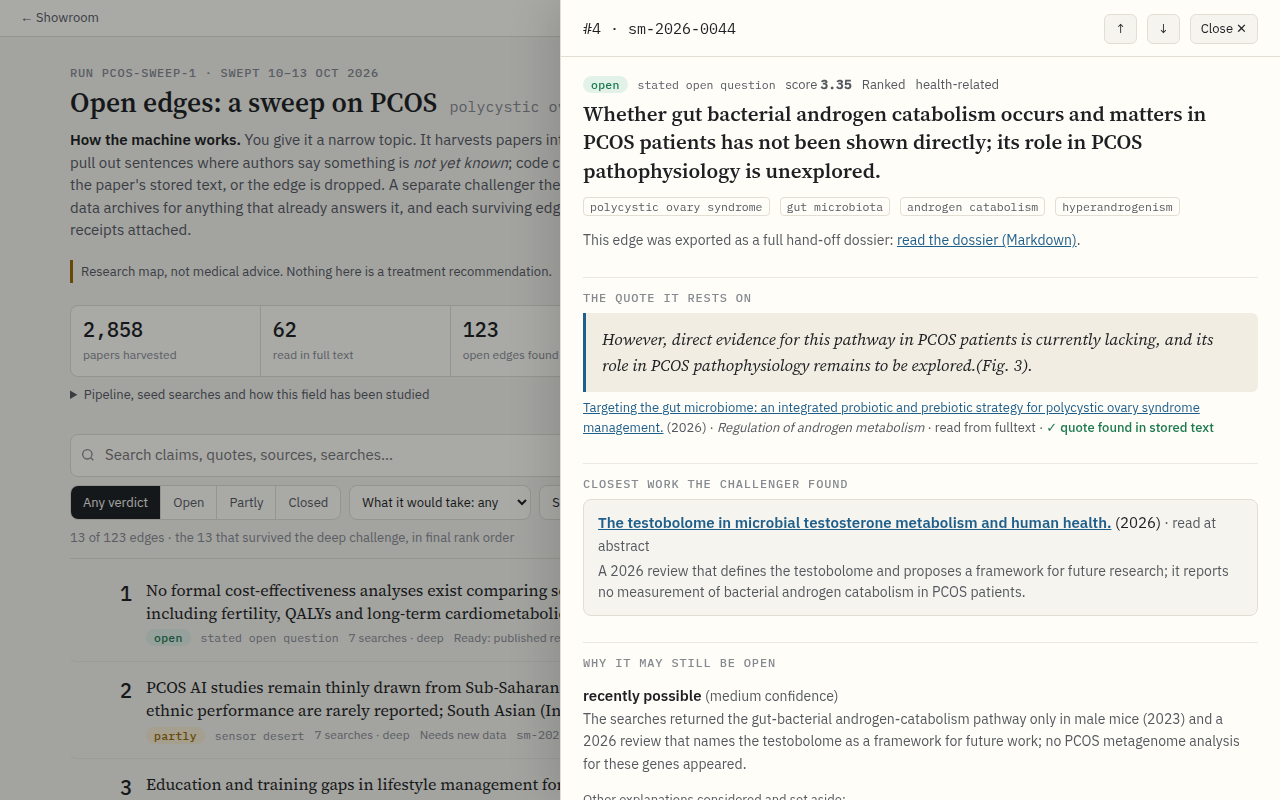
The demo is a read-only explorer of one finished sweep on a biomedical topic (PCOS, a common hormonal condition). It opens on the 13 questions that survived the deep challenge; "All" shows all 123. Click a row to open its drawer: the exact quote with a link to the paper, the scores, the closest work found, a suggested first experiment, and the searches run against it. Search, filter and sort to slice the list. A button opens the same data in GeeGobi. All of it is real output; nothing runs live. This is a research map, not medical advice.
How it works
- Pick a topic and write four to eight search queries with limits.
- The tool pulls matching papers from public scholarly databases into a local file.
- AI agents triage the papers, fetch open-access full text, and pull out candidate gaps.
- Code checks every quote against the stored text; anything not found is dropped.
- Surviving gaps are scored, challenged by a separate skeptic agent, ranked head to head, and grouped.
- It writes a report and spreadsheet files, plus an optional map of what the field has studied.
What exists today
- A command-line pipeline with resumable seed and sweep steps and a cost line per stage
- Quote verification and a separate challenger agent
- An evidence map that counts studies by design, period and intervention
- A check for public datasets that could answer a gap
- Exports into GeeGobi for visual exploration
- One full sweep (123 gaps, 13 top-ranked) and several smaller test runs
What isn't there yet
- Only one topic has been fully swept
- Time and cost on a new topic are not yet measured
- Calibration is early: a handful of test cases, mixed results
- Setup needs Claude Code and about ten minutes; there is no web interface
- Only two subject profiles exist (biomedical, earth and environment)
Under the hood
- Python command-line tool with one DuckDB database per topic
- The code makes no AI calls itself; reading and judging happen in Claude Code agents
- The model never supplies ids, dates or counts; code does anything countable
- Data contracts are frozen in schemas, with tests