What it is
AEP Audit is a health check for Adobe Experience Platform and Customer Journey Analytics, two large systems companies use to collect and report on customer data. These setups drift over time: a dataset gets switched off, a field changes type, a segment quietly redefines itself. The tool takes a "before" and "after" snapshot of the configuration, scores the current one, and writes a report of every change that matters, with a fix list in priority order.
Try it
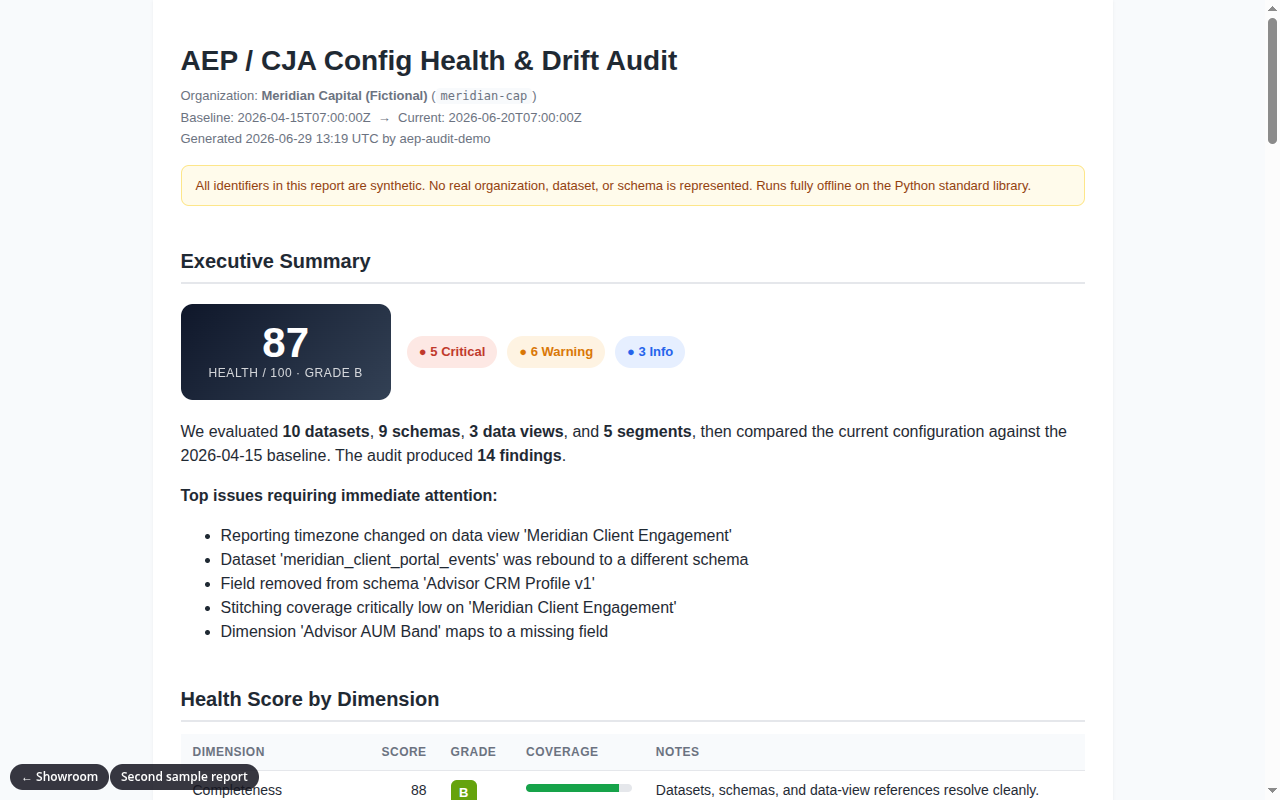
You are looking at two sample reports made by the real engine from two fictional companies: Meridian Capital opens first, and the "Second sample report" button switches to Northwind Retail. Start with the health score and letter grade and the count of Critical, Warning and Info findings, then the score for each of the five dimensions. Scroll through the drift section (what changed between the two snapshots), the detailed findings, and end on the prioritized recommendations. Compare the two companies to see how different problems show up. All the data is invented; no real company's setup is shown. Desktop is easiest.
How it works
- Export two snapshots of the configuration as JSON files: a baseline and the current state.
- Run one command with both files.
- The tool runs health checks on the current snapshot across five dimensions.
- It compares the two snapshots for datasets, schemas, data views and segments.
- It writes a Markdown report and a single-file HTML report with a 0-100 score, grade, drift list and fix list.
What exists today
- Five scored dimensions: completeness, freshness, naming and hygiene, orphaned components, identity stitching
- Drift detection for datasets added, removed, disabled or rebound; schema fields added, removed or retyped; data-view settings; segments created, removed, redefined or swinging in size
- Markdown and self-contained HTML reports
- Two fictional sample companies with before-and-after snapshots
- A hosted page with both sample reports
What isn't there yet
- No collector that pulls a snapshot from a live account; snapshots must be built by hand in the expected format
- Never run against a real live account
- No in-browser version; it runs from the command line
- No history across more than two snapshots
Under the hood
- About 1,000 lines of Python using only the standard library, so it runs anywhere Python 3.8+ exists
- Inputs are plain JSON snapshots; no network access needed
- The HTML report has inline styles and no outside dependencies
- Built clean-room from public documentation and synthetic data only